Potato Chip and Snack Weighing & Packaging Machine
A potato chip and snack packaging machine combines controlled product feeding, multihead weighing, VFFS bag forming, filling and sealing. Potato chips, crisps, tortilla chips, popcorn and puffed foods are low-density and fragile, so the line must manage drop height, seasoning residue, bag volume, film tracking and seal contamination. HYS confirms the final machine, good-pack output and customized options with actual product and film samples.
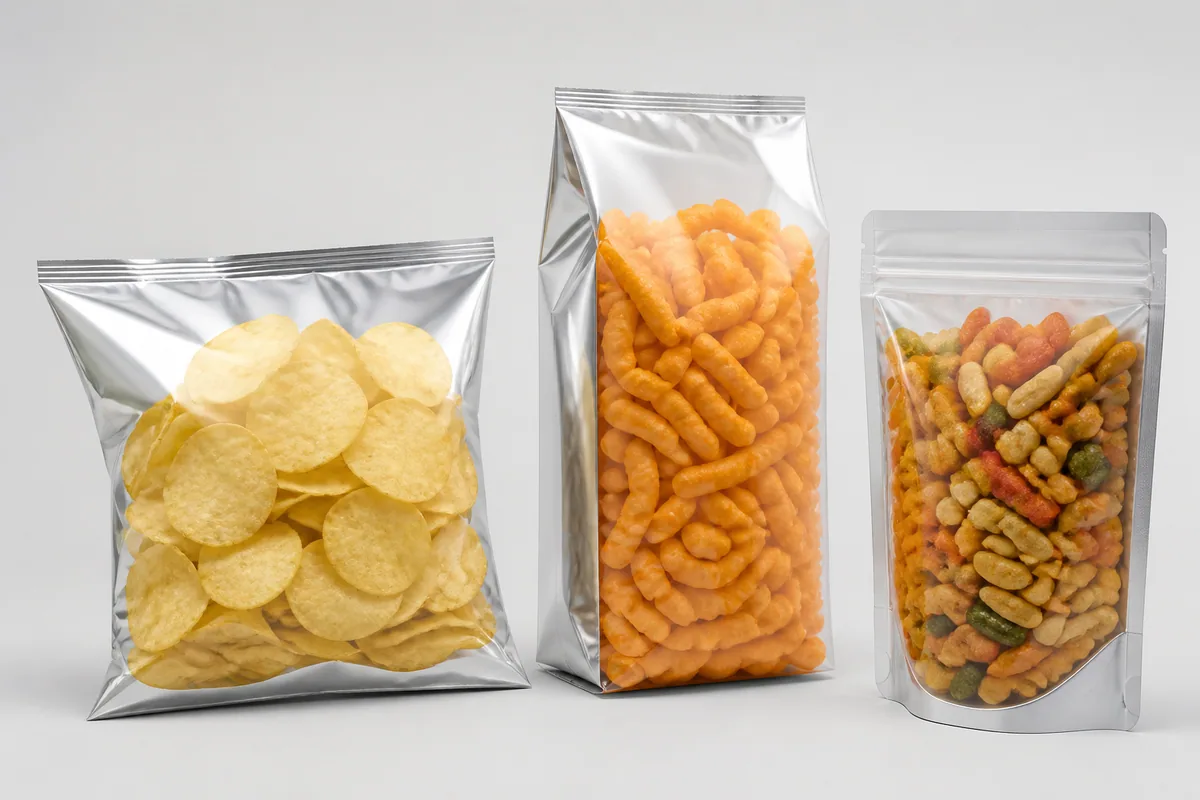
Illustrative packaging example
Potato Chip Weighing & Packaging Line Video
This customer factory video shows potato chip feeding, multihead combination weighing, VFFS bag forming, sealing and finished-pack handling. Final output, breakage and package quality depend on the actual chips, target weight, film and line configuration.
HYS Potato Chip Weighing & Packaging Line
Click to watch the complete potato chip weighing and VFFS bagging process
VFFS Bag Forming Video for Dry Food Products
This VFFS demonstration packages spiral pasta, a different product shape from potato chips but the same vertical rollstock bag-forming, filling, sealing and cutting principle. Product volume, fragility, target weight and bag dimensions must be tested separately for every snack.
Spiral Pasta VFFS Packaging Demo
Click to watch vertical bag forming, filling, sealing and cutting
Published HYS Configuration Facts
- VFFS models list 25–55 bags/min
- VFFS bag sizes extend to L 320 × W 250 mm across the published model range
- The published 0.5–50 g dose range applies to all three VFFS models
- A multihead weigher and gas flushing require project-specific confirmation
Final model, feeder, accuracy and output are confirmed from product and package samples.
Custom functions: Nitrogen flushing, dust extraction, metal detection and checkweighing require a customized machine or line configuration.
Potato Chips, Crisps and Other Snack Products
A snack packaging machine may handle products that share a retail aisle but behave very differently during weighing and bagging. Thin potato chips and potato crisps are light and fragile. Tortilla and corn chips have irregular shapes and sharp corners. Puffed snacks and cheese balls occupy a large bag volume at a low target weight. Popcorn changes in size and density, while pretzels and crackers can break at transfer points.
Seasoned snacks introduce powder and oil to the contact surfaces. Namkeen and mixed snack products may include pieces with different density and flow. Extruded snacks can bridge if the feeder or discharge opening is too narrow. These differences influence the feeder, multihead weigher, forming tube, film width, bag volume and acceptable product drop.
A potato chip packaging machine should therefore be selected from the actual product rather than the word “chips” alone. HYS reviews product dimensions, bulk density, fragility, seasoning, target weight and required package before recommending the VFFS model and weighing system.
Complete Potato Chip Weighing and Packaging Line
A complete potato chip packaging line coordinates product supply, elevation, distribution, multihead weighing, bag forming, filling, sealing and finished-pack discharge. The production video on this page shows a working line rather than only the VFFS bagger. Every section must operate at a compatible rate for stable good-pack output.
A feeder or elevator supplies the snack to the weigher without uncontrolled surges. The multihead weigher builds the target portion and releases it when the VFFS machine is ready. The machine pulls rollstock film around the forming tube, creates the longitudinal seal, receives the snack and completes the horizontal end seal and cut. Finished bags then leave on a conveyor for collection or downstream handling.
Coding, nitrogen flushing, customized checkweighing, metal detection and reject handling must be planned within the line cycle. These functions are not assumed standard. The layout must also consider product loading, platform access, cleaning, operator movement, film replacement and the destination of finished bags.
Multihead Weigher for Potato Chips
A multihead weigher is commonly evaluated for potato chips and irregular snacks because several weigh buckets can create combinations close to the requested target portion. Product is distributed around the top of the weigher, moved into individual buckets and released as a selected combination. The discharge must be synchronized with the VFFS bagging cycle.
The number of weigh heads alone does not determine performance. Chip size, bulk density, hopper fill level, vibration, target weight and allowable giveaway affect each cycle. Large pieces can overlap or bridge. Excessive vibration can increase breakage, while insufficient product supply can leave the weigher waiting and reduce line output.
HYS evaluates the weigher together with the snack packaging machine. A published bagger speed cannot guarantee the same number of finished bags when the product is fragile, bulky or difficult to distribute. Stable output must be measured from acceptable weighed portions, intact snacks and correctly sealed bags.
Reducing Potato Chip Breakage
Fragile snacks can break during elevation, distribution, weighing and discharge. A suitable line reduces unnecessary falling distance, controls vibration and avoids sharp transfer points. Timing hoppers, chutes and the forming tube must provide enough clearance for the product without allowing uncontrolled impact.
The lowest possible drop is not automatically the best setting. Product must still clear the weigher and enter the bag before the sealing jaws close. The correct balance depends on piece size, target portion, bag volume and the mechanical layout. Finished bags should be inspected for both package quality and product damage.
HYS does not promise zero breakage. The customer should define an acceptable breakage level before testing. A potato chip packaging line is considered successful only when it produces repeatable portions, acceptable product condition and clean seals at the required good-pack output.
Low-Density Snacks, Bag Volume and Machine Size
Potato chips and puffed snacks can fill a large package while weighing only a small amount. This is why target weight alone is not enough to select a VFFS machine. The product volume must pass through the forming tube and fit inside the bag while leaving enough space for the end seal.
Film width is determined by the required bag width and product volume. Bag length must provide the intended retail appearance, space above the product and clean seal clearance. A 50 g chip bag can require more film and a larger forming tube than a much heavier bag of dense coffee beans or nuts.
Although the published 0.5–50 g dose range applies to all three HYS VFFS models, bulky snacks may reach the bag-width or volume limit before reaching the weight limit. HYS therefore reviews both weight and loose product volume when selecting the 320, 420 or 520 model.
VFFS Snack Bags, Premade Pouches and Film
VFFS is the primary route for continuous potato chip and snack packaging. It forms bags from printed or plain rollstock film and supports pillow or selected gusseted formats within the machine range. Film thickness, stiffness, friction, print repeat, eye-mark position and heat-seal window affect tracking and finished bag quality.
A premade pouch machine can be evaluated when the product requires a supplied stand-up, zipper or other retail pouch. This route changes the process from film forming to pouch pickup, opening, filling and top sealing. Pouch cost, dimensions, mouth opening, target output and package appearance influence the choice.
| Selection point | VFFS rollstock | Premade pouch |
|---|---|---|
| Typical snack format | Pillow or supported gusseted bag | Stand-up, zipper or prepared pouch |
| Main process | Form, fill and seal from film | Pick, open, fill and top seal |
| Changeover focus | Film, forming parts and bag recipe | Pouch size, grippers and opening |
The final film or pouch must provide the barrier and sealing performance required by the customer. Package appearance alone does not prove compatibility; actual material should be included in the machine test.
Nitrogen Flushing and Snack Freshness
Nitrogen flushing is often requested for potato chips, but it is not assumed for every snack. The gas can replace part of the air in the bag and help create headspace around fragile product. The required process depends on product stability, film barrier, bag volume, sealing, storage conditions and the customer’s shelf-life target.
Nitrogen flushing is a customized function. Gas flow, timing, product displacement and seal formation must be reviewed together. HYS does not publish a guaranteed residual oxygen level or shelf-life extension without a defined test method. The customer is responsible for validating food shelf life, while HYS evaluates the machine cycle and finished-package seal.
Seasoning, Oil and Seal Contamination
Seasoning powder, crumbs and oil can accumulate on feeders, weigh buckets, chutes and the forming tube. If product reaches the horizontal seal area, the film layers may not close consistently. Increasing seal temperature does not remove seasoning or chip fragments trapped between the layers.
The packaging line should provide appropriate contact surfaces and cleaning access. Changeover between flavors may require emptying residual product and cleaning according to the customer’s food-safety procedure. Dust extraction or seal-zone protection can be evaluated as customized functions where the actual snack and process require them.
Snack Product and Bag Changeover
One line may pack potato chips, popcorn and other puffed snacks when every product fits the weighing, volume and bag ranges. A recipe can store target settings, but physical changeover may also require a different forming tube, film roll, guide adjustment, weigher setup and cleaning procedure.
Provide the full product and package matrix before ordering. This allows HYS to identify a common VFFS platform, the change parts required and any product that needs a separate feeding or weighing test. Frequent changes should also be considered when planning operator access and production scheduling.
Send Potato Chips for a Free Machine Test
Customers can mail potato chips, tortilla chips, popcorn, puffed snacks, cheese balls, pretzels or other compatible products to the HYS factory for a free machine-running test. The sample should represent normal production, including realistic piece sizes, breakage, seasoning and oil.
Provide the target weight, acceptable tolerance, loose product volume, bag length, bag width, film roll and required good packs per minute. State the acceptable breakage level and whether nitrogen flushing, coding, metal detection or checkweighing must be evaluated as customized functions.
The test reviews product feeding, multihead weighing, discharge impact, bag forming, film tracking, seal contamination and finished-package appearance. Results apply to the tested snack and film. A successful test for one chip or puffed product does not replace verification of another density, shape, coating or bag size.
Related Packaging Applications
Nuts packaging Candy packaging Pet food packaging Frozen food packaging