Pet Food Packaging Machine for Dog and Cat Food
A pet food packaging machine must be selected around the actual dog food, cat food, kibble, treat or supplement. Dry kibble and treats are commonly weighed into rollstock VFFS bags or premade pouches, while powders and wet products require different dosing systems. Product behavior, bag style, fill weight and shelf-life needs determine the line.
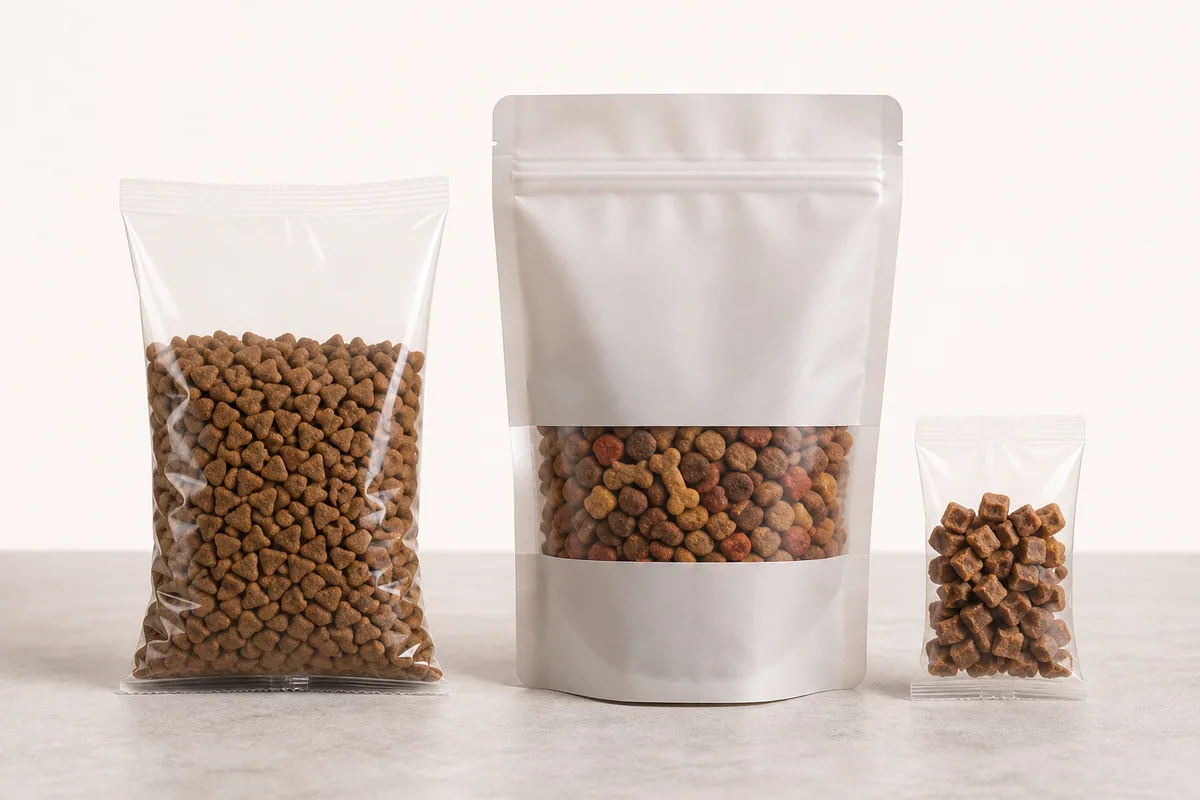
Illustrative packaging example
Pet Food VFFS Packaging Video
This VFFS demonstration shows dry pet food granules moving through dosing, vertical film forming, bag filling, longitudinal sealing, end sealing, cutting and finished-bag discharge. Dog food, cat food, kibble and similar dry granules require their own product, film and target-weight test.
Dog and Cat Food VFFS Packaging Demo
Click to watch dosing, vertical bag forming, filling, sealing and cutting
Pet Food Premade Pouch Packaging Video
This multihead weighing and premade pouch demonstration uses coffee beans to show pouch feeding, opening, filling and top sealing. Dry pet food, kibble and other compatible granules can be evaluated with this route when the product, target weight and supplied pouch fit the selected configuration.
Pet Food Premade Pouch Packaging Test
Click to watch multihead weighing, pouch opening, filling and top sealing
Published HYS Configuration Facts
- VFFS models list 25-55 bags/min and bags up to L 320 x W 250 mm
- PY-210G premade pouch page lists 60-100 bags/min
- PY-210G lists pouch sizes W 50-95 mm x H 100-280 mm and up to 200 g
- The feeder and package route must be confirmed from the pet-food sample
Final model, options, accuracy and output are confirmed from product and package samples.
Custom functions: Nitrogen flushing, dust extraction, metal detection and checkweighing require a customized machine or line configuration.
Choose the Packaging Platform
- Use VFFS when rollstock bags, broad weight ranges and efficient continuous bag production are priorities.
- Use a rotary premade pouch machine for zipper, stand-up or other supplied pouch styles.
- Dry powders may require an auger filler; free-flowing kibble commonly uses a multihead or linear weigher.
- Wet or semi-solid pet food requires a compatible pump or dosing system and a pouch designed for the product.
Dog Food, Cat Food and Pet Treat Formats
- Dry dog food and cat food: free-flowing kibble is commonly paired with a multihead or linear weigher and a VFFS bagger.
- Pet treats: biscuits, dental chews and irregular treats require gentle transfer, suitable weighing and enough seal clearance.
- Powders and supplements: fine or dusty products may require an auger filler, dust control and a product-specific cleaning plan.
- Retail formats: pillow and gusseted rollstock bags favor VFFS efficiency, while supplied zipper or stand-up pouches favor a premade pouch machine.
Product and Bag Requirements
- Provide product size distribution, oiliness, dust, fragility and target fill weight.
- Confirm pillow, gusseted, block-bottom, zipper or stand-up bag requirements.
- Specify film or pouch structure, oxygen/moisture barrier and seal contamination risk.
- Define coding, nitrogen flushing, check weighing and metal detection requirements.
Sanitary and Production Considerations
- Food-contact construction and cleaning access should match the customer’s process and market requirements.
- Dust and oil control affect weighing accuracy, sealing and maintenance.
- Output must be tested with the actual product and selected package.
Related applications: grain and seed packaging, nuts packaging, and snack packaging.
How Pet Food Characteristics Affect Machine Selection
A pet food packaging machine should be selected from the physical behavior of the product rather than the words “dog food” or “cat food” alone. Dry kibble may look similar to coffee beans, nuts or cereal pieces, but differences in bulk density, surface oil, dust and size distribution affect every weighing cycle. Small uniform kibble can flow quickly through a multihead or linear weigher. Large dental treats or irregular pieces may bridge in a hopper, overlap at discharge or suffer damage from unnecessary drop height.
Before choosing a dog food packaging machine or cat food packing machine, HYS reviews the smallest and largest pieces, target weight, acceptable tolerance, product temperature and whether fines collect around the sealing area. Oily coatings can transfer to contact surfaces and film. Dusty supplements can require different dosing and cleaning arrangements. A product that runs well in one bag size may behave differently when the target weight, discharge opening or pouch mouth changes.
Pet Food Weighing and Dosing Options
Free-flowing kibble and small treats are commonly evaluated with a multihead weigher because combinations of weigh buckets can build the requested target weight before each discharge. A linear weigher may suit simpler products or production targets. Fine pet food powder and supplements behave differently from kibble and may require an auger filler. The packaging machine forms or handles the bag, but the dosing system determines how product reaches that bag.
The correct pet food weighing and packing machine combines feeder capacity, dosing method, discharge timing and bag cycle. Hopper angles, vibration settings and product-contact finishes influence flow and residue. When several recipes share one line, changeover must include cleaning, recipe selection and confirmation that every product remains within the machine’s bag and dosing ranges. Published speed is not the same as verified good-bag output; the complete cycle must be tested with the actual product.
VFFS Rollstock Bags or Premade Pet Food Pouches
A VFFS pet food packaging machine forms each package from rollstock film. It is generally considered when repeat production, pillow bags and efficient film use are priorities. Product is weighed above the machine, discharged through the forming tube and sealed into the finished bag. Film width, bag length, product volume and seal clearance must all fit the selected model.
A premade pouch machine handles supplied bags instead of forming them from rollstock. This route is useful when the commercial package requires a zipper, stand-up format, shaped pouch or another prepared style. Pouch pickup, opening, filling and sealing depend on consistent pouch dimensions and a clean pouch mouth. Premium appearance alone does not determine the choice: pouch cost, output, changeover, filling behavior and available factory space also matter.
The current HYS PY-210G published configuration lists pouch sizes of W 50–95 mm by H 100–280 mm and product weights up to 200 g. Larger pet food bags or different pouch sizes are not assumed to fit this standard configuration and require a separate engineering review.
VFFS and Premade Pouch Comparison for Pet Food
| Selection point | VFFS packaging machine | Premade pouch machine |
|---|---|---|
| Packaging material | Rollstock film formed into each bag | Finished pouches supplied to the machine |
| Typical pet food format | Pillow bags and supported rollstock bag styles | Stand-up, zipper and other prepared pouches |
| Product route | Weigh, form, fill and seal in a continuous vertical cycle | Pick up, open, fill and top-seal each pouch |
| Changeover focus | Film, forming parts, bag length and target weight | Pouch dimensions, grippers, opening and top-seal settings |
| Best review input | Product volume, target weight and film roll | Actual pouch samples, product and target fill weight |
Pet Food Bags, Film and Seal Protection
Pet food may be sold in pillow bags, gusseted rollstock bags, stand-up pouches or zipper pouches. The correct format depends on fill volume, shelf presentation, consumer opening and storage after opening. Film stiffness and friction affect tracking through a VFFS machine, while premade pouch thickness and surface finish affect pickup and opening. Printed film also requires an accurate eye-mark position and enough repeat length for the finished bag.
Barrier performance and shelf-life requirements belong to the selected packaging material and validated process. The machine must produce repeatable seals without kibble, crumbs, powder or oil entering the seal area. Nitrogen flushing can be evaluated when the product and package specification requires it, but it is a customized function. The same applies to dust extraction, metal detection and checkweighing.
Planning a Complete Pet Food Packaging Line
A complete pet food packaging line coordinates product loading, elevation, weighing, discharge, bagging, sealing and finished-pack transfer. If one section cannot match the next section’s cycle, the theoretical speed of an individual machine will not become stable production output. Product accumulation, discharge height, access for cleaning and operator movement should be reviewed in the line layout.
Coding, gas flushing and inspection consume space and cycle time. A buyer should define which functions are required, where rejects must leave the line and whether finished bags continue to a collection table or downstream equipment. HYS uses these requirements to recommend a practical configuration; final accuracy and output remain subject to sample testing.
Send Pet Food Samples for a Free Machine Test
Customers can mail dog food, cat food, kibble, pet treats or compatible granules to the HYS factory for a free machine-running test. The sample should represent normal production, including realistic variation in piece size, dust and coating. Send the target weight, bag dimensions, film roll or premade pouches, required output and any coding or customized inspection requirements.
HYS checks product flow, dosing compatibility, bag clearance, pouch opening or film tracking, seal contamination and finished-package appearance. A successful test for coffee beans or another granule is useful process evidence, but it does not replace testing the customer’s actual pet food.