Biscuit and Cookie Packaging Machine and Flow Wrapper
A biscuit or cookie packaging machine can flow-wrap single pieces, controlled stacks, sandwich cookies, wafer biscuits or tray-supported packs. Because these products are fragile and produce crumbs, stable HFFS output depends on gentle infeed control, repeatable spacing and keeping product fragments away from the end seals.
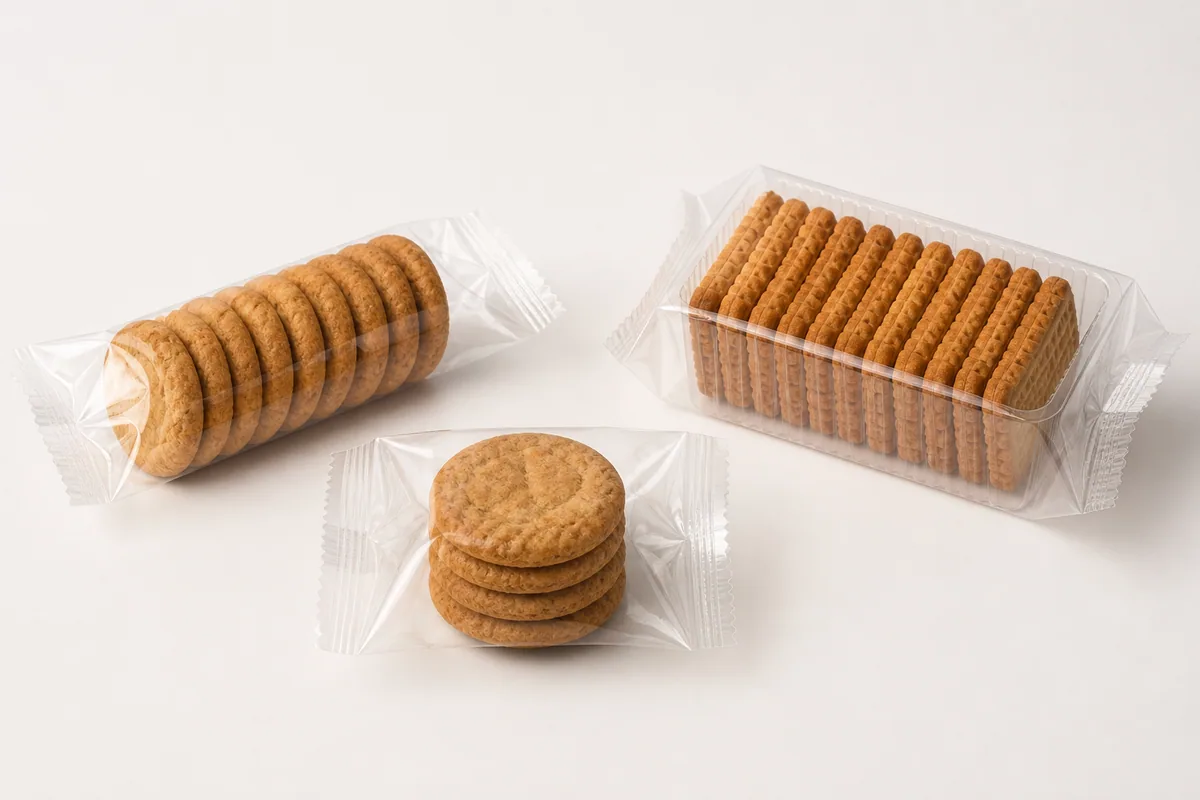
Illustrative packaging example
Live Video Demonstration
Watch the HFFS horizontal flow wrapper feed, seal and cut individual biscuits into pillow packs in this customer-style production demo.
HYS Biscuit HFFS Flow Wrapping Machine Demo
Video ID: YODOTAZ_av8 | Click to play YouTube demonstration video
Published HYS Configuration Facts
- HFFS model range: HFS-260, HFS-350 and HFS-450
- Published speed range: 20–250 packs/min
- Published finished bag widths: 25–110, 25–150 and 50–200 mm by model
- Published suitable film thickness: 0.03–0.06 mm
Final model, options and output are confirmed from product and package samples.
Custom functions: Nitrogen flushing, dust extraction, metal detection and checkweighing require a customized machine or line configuration.
Biscuit and Cookie Pack Formats
- Single biscuits and cookies: require reliable pitch and orientation before each product enters the film.
- Counted stacks: need stack control, suitable guides and gentle acceleration to prevent collapse.
- Sandwich biscuits: must be reviewed for cream transfer, edge damage and seal-zone cleanliness.
- Wafer biscuits and tray packs: require low-impact handling and enough package clearance to protect fragile edges.
Single, Stack and Tray Feeding
- Define whether the product is one piece, a counted stack or supported in a tray.
- Automatic feeding must match product diameter, thickness, fragility and upstream arrival pattern.
- Guides and flights should prevent rotation, edge impact and stack collapse.
- Broken pieces and crumbs must be managed before they reach the sealing jaws.
Film and Seal Protection
- Provide the actual film structure, thickness, friction and print-registration details.
- Bag length must leave enough clearance for clean end seals without contacting the biscuit.
- Tray dimensions, easy-open features and barrier requirements affect forming and sealing.
- Seal appearance and breakage rate must be verified together at the target production speed.
Test Information
- Product dimensions, stack count, tray details and acceptable breakage level.
- Target bag dimensions and printed or plain film roll.
- Required good packs per minute and upstream supply rate.
- Manual, semi-automatic or fully automatic feeding requirement.
Related applications: bread packaging, chocolate bar wrapping, and bakery flow wrapping.
Flat-on-Pile, On-Edge and Slug Biscuit Packs
A biscuit packaging machine must match the way the product is presented before it reaches the film. Flat-on-pile packs place biscuits in a horizontal stack. On-edge or slug packs arrange round or rectangular biscuits vertically in a controlled row. Single biscuits and cookies travel as individual products, while family packs may use a tray to support several rows.
Each presentation changes the feeding problem. A flat stack must stay aligned and resist collapse during acceleration. An on-edge slug needs controlled length, side support and a stable transfer into the wrapper. Tray-supported biscuits depend on consistent tray dimensions and correct product loading before the tray reaches the machine. A single cookie needs accurate pitch so that the end-sealing jaws close between products.
The HFS-260, HFS-350 and HFS-450 provide different published bag-width and product-height ranges. This does not mean every stack, slug or tray will run on a standard setup. The forming box, guides, conveyor flights and feeding system must be selected from the actual product and finished package.
Automatic Biscuit Feeding, Counting and Line Control
Manual feeding is practical for trials, low output or products that cannot yet be presented automatically. Operators place each biscuit, stack or tray into the correct conveyor position. Semi-automatic feeding can add counting, grouping or controlled transfer while retaining manual loading. A fully automatic biscuit packaging line connects the oven or cooling conveyor to product distribution, counting, stacking and the horizontal flow wrapper.
Automatic feeding must respond to gaps, rotated products, broken pieces and changes in upstream flow. The goal is not simply to move products faster. It is to deliver the correct count and orientation at a repeatable pitch without creating extra impact. Sensors, conveyors and servo motion must work with the package cycle so that the sealing jaws do not meet the product.
Different products may require different feeding modules. A cookie arriving in random orientation is not the same as an ordered row of crackers. HYS reviews the upstream supply pattern, product dimensions, target count and required good packs per minute before defining the automatic feeding scope.
Reducing Biscuit Breakage and Crumbs at the Seal
Biscuits, cookies, crackers and wafers can break at transfers, during grouping or when guides apply too much pressure. Product damage is influenced by recipe, thickness, temperature, moisture, inclusions and the acceptable package clearance. A suitable line minimizes unnecessary drops, controls acceleration and keeps transfer gaps small enough for the product.
Crumbs create a second problem. Loose fragments can collect on conveyors, enter the forming area or become trapped in an end seal. The line layout should provide cleaning access and a way to remove broken pieces before sealing. Seal temperature alone cannot compensate for product contamination between the film layers.
The acceptable breakage rate must be agreed before testing. A machine can produce a closed package while still damaging too many products. HYS therefore evaluates feeding stability, finished-pack appearance and product condition together rather than reporting only mechanical cycles per minute.
Packaging Film, Freshness and Seal Quality
Biscuit and cookie packaging commonly uses heat-sealable roll film to create pillow packs. The material may need moisture or oxygen barrier properties according to the product and required shelf life. Those properties come from the selected film structure and the validated package, not from the wrapping machine alone.
Film width, thickness, stiffness and friction affect forming and tracking. Printed film requires a suitable eye mark and repeat length. Bag length should leave enough space beyond the biscuit, stack or tray for both end seals. Too little clearance increases the risk of product contact; excessive clearance wastes film and can reduce the desired retail appearance.
Seal temperature, pressure and dwell time must be tested with the actual film. Easy-open features, gusseting, coding or tray use should be included in the sample review. HYS confirms the supported package only after checking the product, forming parts and film together.
Changeover Between Biscuits, Cookies, Crackers and Wafers
One flow wrapper may handle several products when every format fits the machine range, but a stored recipe does not complete the whole changeover. Operators may need to adjust conveyor guides, flight spacing, forming parts, film rolls, temperature settings and product sensors. Stack count or tray changes can also require a different feeding arrangement.
Before selecting an automatic biscuit packing machine, provide the complete product list instead of one representative size. This allows the project to identify a common machine platform, the change parts required and any products that need a separate test. It also prevents an apparently small future product from falling outside the available guide or forming range.
Free Biscuit and Cookie Packaging Test
Customers can mail biscuits, cookies, crackers, sandwich biscuits, wafer biscuits or tray samples to the HYS factory for a free machine-running test. Include product dimensions, stack count or slug length, tray dimensions, target bag size, printed or plain film and the required production output. State the acceptable breakage level and whether feeding will be manual, semi-automatic or connected to an upstream line.
The test checks product transfer, orientation, grouping stability, film forming, seal clearance, crumb contamination and finished-package appearance. The published HFFS speed range remains a machine rating; stable good-pack output is confirmed from the tested product, film and feeding arrangement.
Biscuit Packaging Machine Buyer Checklist
Prepare a product matrix covering every biscuit, cookie, cracker and wafer planned for the line. Record dimensions, weight, shape, surface condition, stack count, tray use and acceptable breakage. Explain how products leave the oven or cooling conveyor and whether they arrive in lanes, random orientation or prepared groups.
For the package, provide bag length, bag width, film structure, print repeat, eye-mark location, easy-open requirements and the required seal appearance. State the target good packs per minute and expected changeover frequency. This information helps determine whether a standard horizontal flow wrapper is sufficient or whether customized counting, stacking, tray handling, inspection or automatic feeding is required.